
Saying Goodbye to Streamlit
Picture a food truck that's been serving your neighborhood for years. The menu is good. The regulars love it. But the line is getting longer, the kitchen can barely fit two people, and customers keep asking if you deliver. The truck got you started, but it can't take you where you need to go.
That was Streamlit for Manuscript Alert, the research paper discovery tool that DK and I have been building for Alzheimer's disease and neuroimaging researchers. This is the first post in a series about moving out of the truck and into a proper restaurant.
A Tool That Found Its Audience
If you study Alzheimer's disease, keeping up with new research is part of the job. Papers come out constantly across multiple databases. Missing a relevant one can mean duplicating someone else's work or overlooking a technique that could save months of lab time.
Manuscript Alert pulls papers from these databases, scores them against your research interests, and presents everything in one place. A personalized paper feed, tuned to your specific corner of neuroscience.
Streamlit was the perfect food truck for this idea. It turns scripts into web apps with almost no setup. We had a working tool in days. DK could search for papers, adjust keyword weights, export results. The whole thing ran from a single recipe book: one file, 1,562 lines, doing everything.
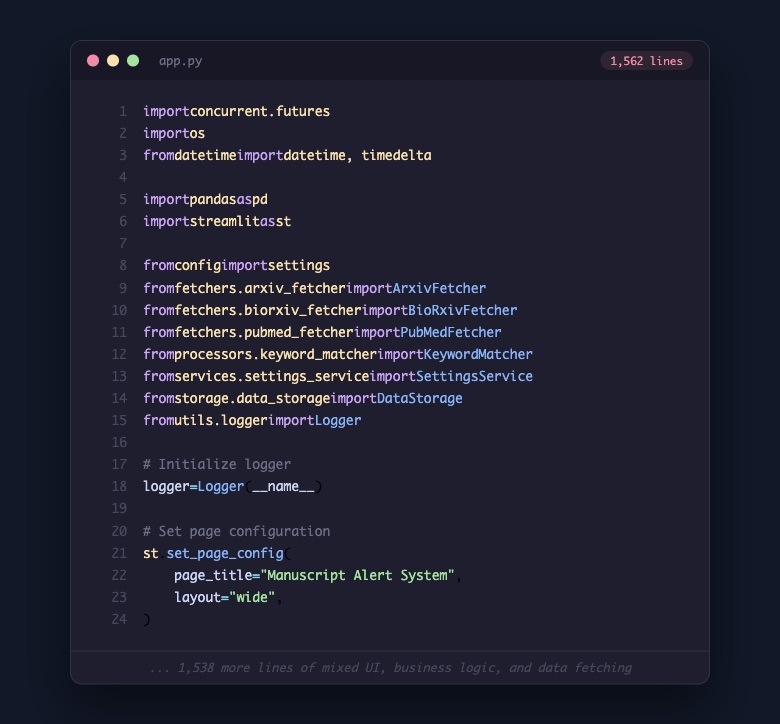
For a while, the truck was full every day and the food was good. That was what mattered.
When the Line Gets Too Long
The problems weren't dramatic. They were the kind that build up quietly, one small frustration at a time.
DK wanted to check papers on his phone between meetings. The truck doesn't have a drive-through. A request for better sorting meant squeezing another burner into a kitchen that was already shoulder-to-shoulder. Every improvement bumped against the same three walls:
The truck doesn't travel. Researchers aren't always at their desks. They read papers on the train, at conferences, between experiments. A tool that only works on one laptop is like a restaurant with no front door.
The menu is fixed. Streamlit gives you a UI, but it's Streamlit's UI. You can't redesign how results look or how different views flow into each other. For a tool people rely on daily, that lack of flexibility starts to feel like a ceiling.
One kitchen, one cook. With everything in one file, any change meant understanding the entire operation. DK and I would hesitate before touching anything because adjusting one dish might throw off three others.
Deciding to Move
This wasn't a snap decision. We spent time comparing options and talking through what researchers actually needed.
We looked at several paths. Renovating the truck. Opening a different kind of truck. Each had tradeoffs. What tipped the balance toward building a proper restaurant was a practical question: which setup would let us serve the experience researchers were asking for?
Mobile-friendly paper browsing. Customizable layouts. Real-time updates when new papers match your interests. Eventually, an assistant that understands your research. That menu needs a kitchen designed for it.
Clearing the Lot
Once we committed, the actual teardown was fast. We weren't demolishing the business. We were taking apart the truck so we could reuse the best parts in the new building.
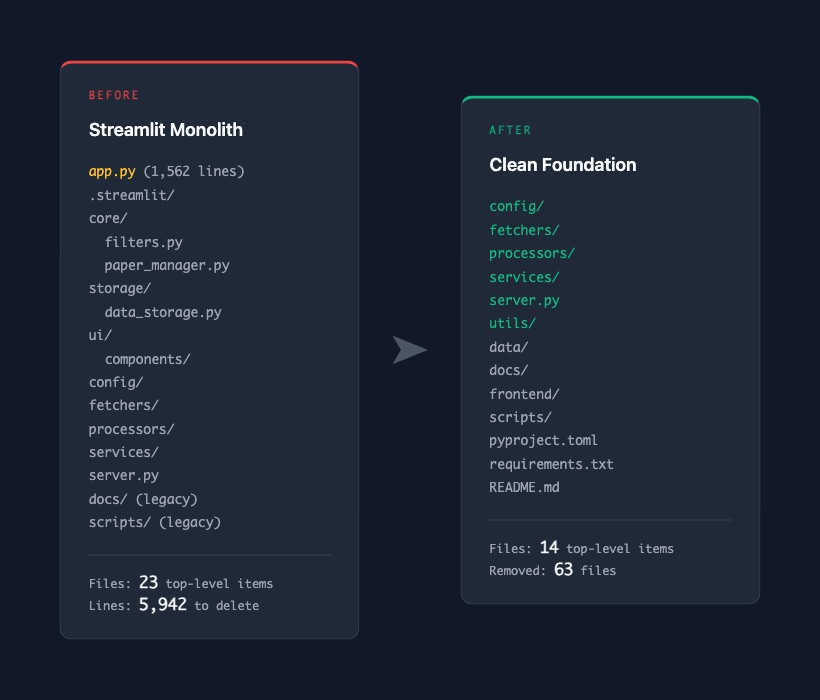
The core stayed. Everything that fetches papers from research databases? Kept. The engine that scores papers against research interests? Kept. The services that manage settings and backups? Kept. The existing API that was already running alongside Streamlit? Kept.
What came down was the truck itself: the single-file interface, the truck-specific components, the caching designed around Streamlit's model, and the legacy scripts from an older setup. The parts that only made sense when everything had to fit in one vehicle.
A Foundation, Not a Finish Line
After the commit, the lot was clear. Where there had been a cramped truck with everything piled on top of itself, there was now open ground with the kitchen equipment neatly staged and ready for the new building.
DK ran through his daily routine to make sure the core still worked without the truck around it. Paper searches across all three databases. Loading saved configurations. Checking that his keyword weights were intact. The food was fine. It just didn't have a counter to serve it from yet.
More importantly, the project now reflected what Manuscript Alert actually is: a paper discovery engine ready for a proper home. Streamlit was a great way to get the tool into researchers' hands quickly, and it did that job well. But DK's needs outgrew what a food truck could offer, and that's okay.
What's Next
The lot is cleared, but we don't have blueprints yet. Before laying a single brick, I needed to map out every step from here to a deployed application with cloud hosting, AI-powered discovery, and a knowledge base that remembers what you've already read.
That plan is the subject of the next post.