
Donation Mentoring
Visit Live SiteEvery mentoring session becomes a UNICEF donation. Connecting mentees with experienced professionals while creating social impact.
Led complete UI/UX redesign: filtering system, dark/light mode, design system, and streamlined booking flow
30+
Mentor of the Day
12 fields
1 click
KR / EN
Random order ensures every mentor gets visibility
The User Journey
Discover
Find mentors by expertiseExplore
View standardized profilesBook
One-click calendar schedulingMeet
1:1 mentoring sessionImpact
Session fee → UNICEF donationThe Evolution
From Notion prototype to production platform—each version solved real user problems and taught us something valuable.
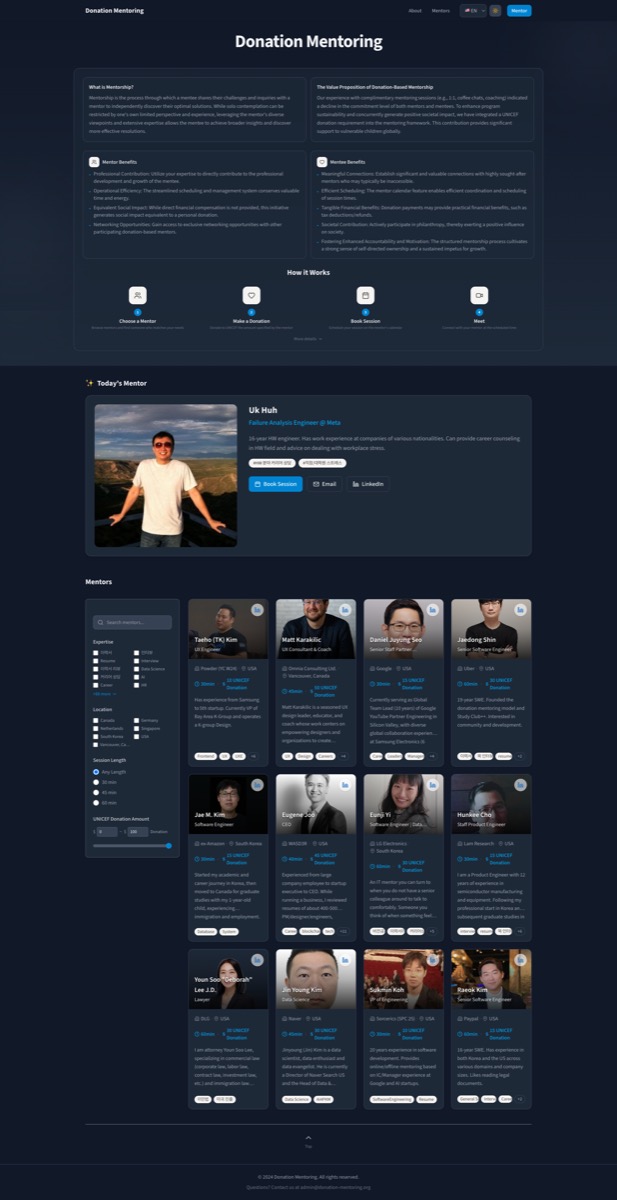
Platform Redesign
2026 - Ongoing
Zero-friction booking. Self-maintaining platform. Fair visibility for all mentors.
Good UX isn't about adding features—it's about removing obstacles. Every click you eliminate is a user you keep.
With 30+ mentors across diverse fields, users struggled to find the right match. No search, no filters - just endless scrolling.
Mentee 1: "I can't filter by expertise or location. I have to scroll through everyone."
Mentee 2: "Every mentor has a different profile style. Is this even a real platform?"
Mentor 1: "I want to update my availability but I can't edit my own page."
Admin 1: "There's no way to announce updates. I have to message everyone individually."
A complete UX overhaul focused on discoverability and frictionless booking. Mentors manage their own profiles, keeping information fresh without admin overhead.
Self-hosted infrastructure
Full control over data, no vendor lock-in, zero monthly hosting costs. Sustainability matters for a nonprofit.
Decentralized content ownership
Mentors manage their own profiles. No admin bottleneck, always up-to-date availability.
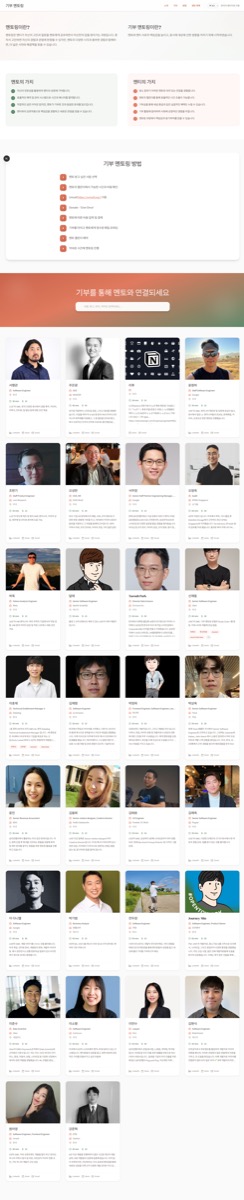
Custom Web App
Late 2025
Built by Jaedongshin (project owner)
A functional platform that solved the core problems. Foundation laid for future improvements.
Moving off Notion was necessary. But the first custom build is rarely the final form.
Notion couldn't scale. The inconsistent profiles and maintenance burden made it clear: we needed a real platform.
"Every mentor page is different. I can't compare them."
"No search, no filter. Just endless scrolling."
Migration from Notion to a custom Next.js application with Supabase backend. Standardized mentor cards replaced freeform pages. Bilingual support (Korean/English) expanded reach.
Next.js + Supabase stack
Modern, scalable, and familiar to the development community.
Standardized card layouts
Consistency enables comparison. Same structure, different content.
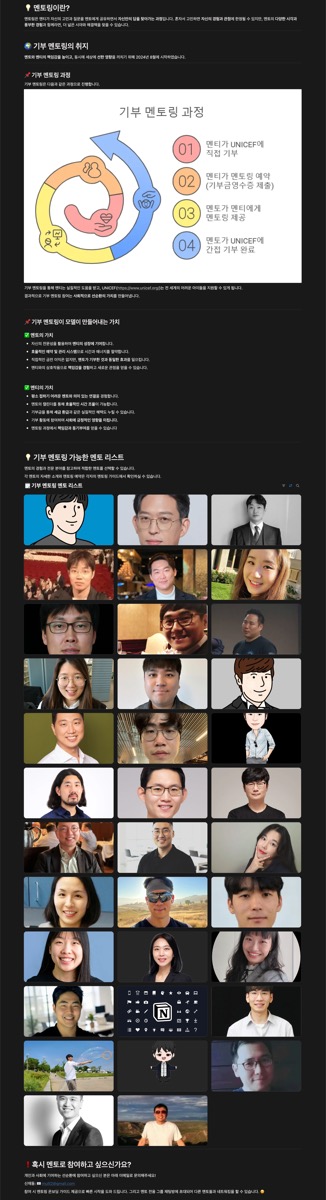
Notion Platform
2024 - Late 2025
The platform ran successfully for over a year. But as the mentor list grew past 30, the cracks became canyons. What felt personal at 8 mentors felt chaotic at 30+. The traction that validated the program also broke the platform.
Tools that serve you at one scale can strangle you at another. Notion was the right choice for year one. Recognizing when to graduate from a tool is as important as choosing it in the first place.
When the mentoring program started with a handful of mentors, Notion made perfect sense. Free, familiar, and already part of everyone's workflow. A dedicated website felt like overkill for such a small group. But what works at small scale rarely survives growth.
"Only the admin can edit pages. Every time a mentor wants to update their availability, they have to message me and wait."
"Each mentor built their page differently. Some have photos, some don't. Some list their expertise clearly, others bury it in paragraphs. Mentees don't know what to expect."
"There's no way to search or filter. Mentees have to scroll through everyone and hope they find someone relevant."
"The same few mentors get all the bookings. Others are invisible because they're buried at the bottom of a long list."
"As we added more mentors, the maintenance burden grew exponentially. Keeping everything updated became a part-time job."
Each mentor maintained their own Notion page independently, working around the admin-only editing restriction. An aggregation page linked all mentor profiles together. The system worked. For a while.
No custom domain on free tier -> stuck with notion.site URLs that look unprofessional
Basic SEO only -> can't customize meta tags per page, poor Google discoverability
No search or filtering -> users must scroll through all content manually
Limited design options -> can't match brand colors, stuck with default fonts
"Built with Notion" badge -> undermines professional credibility
Slow load times on larger pages -> Notion wasn't built for public websites
Notion as the primary platform
With only a few mentors, building a custom website felt unnecessary. Notion was free, everyone knew how to use it, and it could go live immediately. The right tool for that moment.
Mentor-owned pages
Notion's free tier restricted editing to admins only. Letting each mentor own their page was the only way to give them autonomy over their own information.
Organic growth over structure
No templates, no guidelines. Each mentor expressed themselves freely. Authenticity mattered more than consistency when the community was small and personal.